Compliance Audit: Definition, Process, Types, Benefits, and Best Practices
TL;DR
A compliance audit evaluates adherence to regulations, standards, contracts, and internal policies.
Effective audits require defined criteria, qualified auditors, objective evidence, clear reporting, and timely corrective action.
Audit scope may cover quality, safety, privacy, finance, environmental obligations, information security, or suppliers.
Risk-based planning focuses resources on areas with the greatest potential impact.
Connected technology improves evidence collection, traceability, CAPA follow-up, reporting, and enterprise visibility.
Regulated organizations manage growing volumes of requirements, records, systems, suppliers, and stakeholder expectations. Last-minute document collection and informal reviews are no longer enough to show that controls work consistently.
A structured compliance audit evaluates performance, identifies gaps, assigns accountability, and verifies whether written requirements are reflected in daily practices.
A compliance audit is a systematic, documented evaluation of whether an organization follows applicable laws, regulations, standards, contractual obligations, and internal policies. Auditors review objective evidence including procedures, records, controls, interviews, observations, and system data to determine conformity, document gaps, and support corrective action.
What Is a Compliance Audit?
A compliance audit is a systematic, documented assessment of whether an organization follows applicable regulations, industry standards, contractual requirements, and internal policies. It examines objective evidence to determine whether established controls and operational practices are working as intended.
What is compliance auditing?
It is the broader process of planning, performing, documenting, and following up on these assessments. Activities may include document reviews, interviews, observations, transaction sampling, access-control testing, and verification of corrective-action effectiveness.
What Is Audit and Compliance?
Compliance establishes what an organization must do. Auditing checks whether it is actually doing it.
This relationship creates accountability. Compliance teams translate requirements into controls, while auditors independently evaluate whether those controls are implemented and supported by evidence.
A practical audit compliance definition is the condition in which processes and records conform to the criteria selected for an audit. Compliance and audit are therefore connected but distinct responsibilities: building the control environment and objectively testing it.
Why Are Compliance Audits Important?
Compliance audits can reveal outdated procedures, incomplete training, weak controls, inconsistent supplier oversight, and ineffective corrective actions.
They help organizations:
Identify gaps and verify control effectiveness
Improve documentation and record traceability
Strengthen ownership and accountability
Prepare for regulatory or certification inspections
Reduce repeated nonconformities through root-cause analysis
Protect customers, employees, data, assets, and reputation
Provide management with evidence for prioritizing improvement
Compliance and auditing can also expose inefficient handoffs, duplicated controls, and recurring risks.
What Are Compliance Audits Designed to Evaluate?
What are compliance audits intended to examine? The answer depends on scope and criteria. Common review areas include policies, regulatory obligations, employee training, document control, information security, health and safety, financial controls, data integrity, user access, corrective actions, supplier compliance, and management oversight.
Each test should connect to a specific requirement, preventing vague findings and improving follow-up.
Types of Compliance Audits
Common types include:
Regulatory, internal, external, or third-party audits
Quality, environmental, health and safety audits
Information security and data privacy audits
Financial compliance and internal-control audits
Supplier and third-party compliance audits
Industry-standard or certification audits
Criteria may involve ISO standards, FDA requirements, OSHA rules, HIPAA, GDPR, SOC 2, PCI DSS, or SOX. Confirm applicability with qualified professionals.
Internal Audit vs. Compliance Audit
Comparison Area | Internal Audit | Compliance Audit |
|---|---|---|
Primary purpose | Evaluate controls, governance, performance, and readiness | Verify adherence to specified requirements |
Scope | Operational, financial, strategic, IT, quality, or compliance risks | Defined by a regulation, standard, contract, or policy |
Auditor | Internal team or independent internal resource | Internal specialist, regulator, certification body, customer, or third party |
Frequency | Annual or risk-based program | Scheduled, required, or triggered by change or events |
Governing criteria | Internal policies, objectives, frameworks, and risks | External and internal compliance criteria |
Intended audience | Management, audit committee, or board | Management, regulators, customers, or certification bodies |
Reporting | Weaknesses, recommendations, and risk ratings | Conformities, findings, evidence, and required actions |
Follow-up | Management action tracking | Corrective action, CAPA, and closure verification |
Internal audits often test readiness and internal control performance. External compliance audits may formally verify conformance to requirements imposed by regulators, customers, or standards bodies.
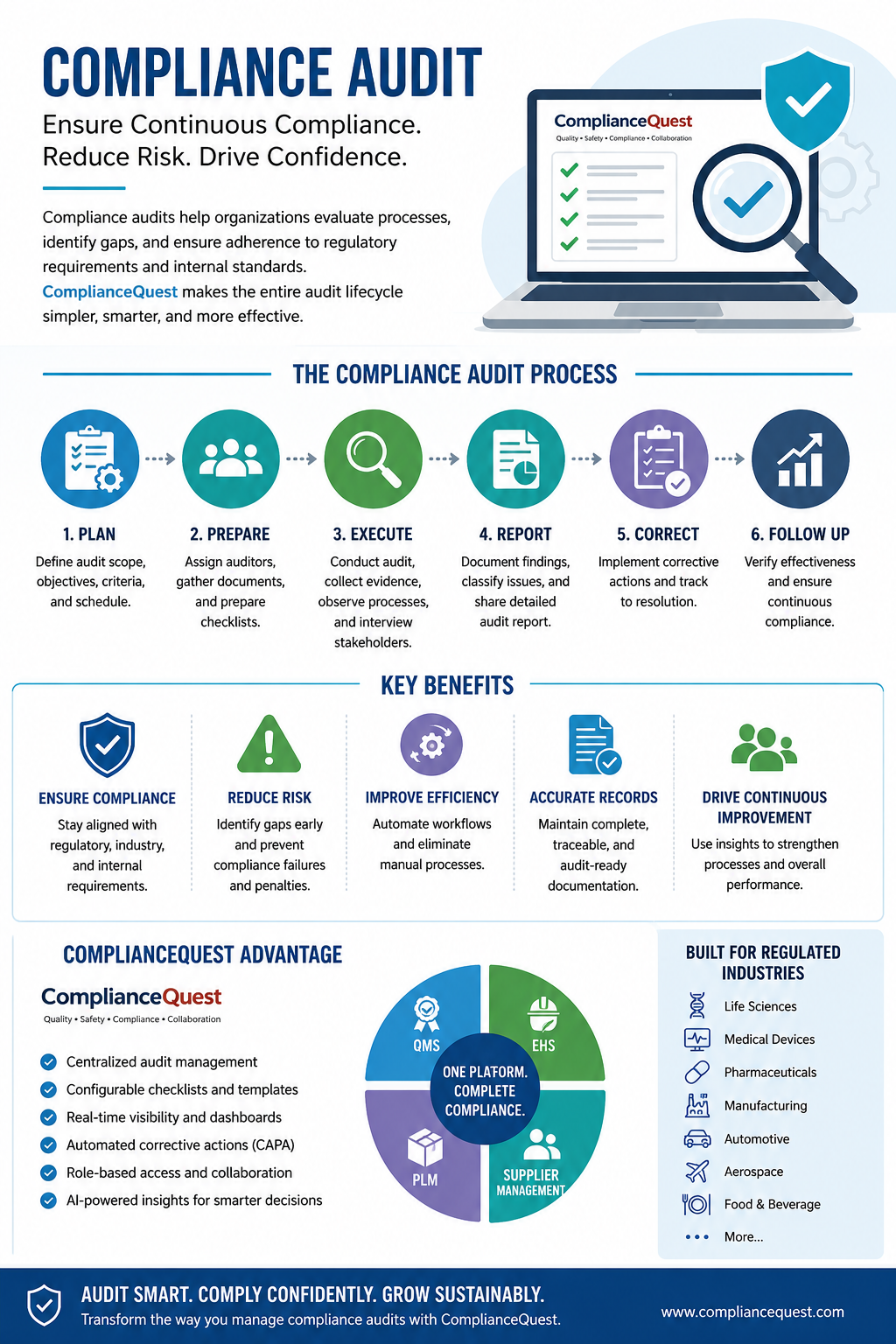
The Compliance Audit Process Explained Step by Step
Identify applicable requirements. Create a controlled list of laws, standards, contracts, policies, and obligations.
Define objectives and scope. Specify locations, functions, systems, time periods, exclusions, and criteria.
Select qualified compliance auditors. Match expertise to the subject and manage conflicts of interest.
Develop the plan and checklist. Convert requirements into testable questions, evidence requests, interviews, and samples.
Gather documents and evidence. Review procedures, records, training, logs, approvals, risks, and prior findings.
Conduct interviews, observations, and testing. Compare written controls with actual practices.
Record findings and evidence. State the requirement, evidence reviewed, and basis for the conclusion.
Classify gaps or nonconformities. Apply consistent severity criteria based on risk, recurrence, scope, and impact.
Prepare and communicate the report. Present findings, evidence, positive practices, and agreed actions.
Assign corrective and preventive actions. Define containment, root cause, owners, deadlines, and proportionate action.
Verify effectiveness. Confirm that actions address the cause and prevent recurrence.
Close and monitor. Retain records, trend findings, update risks, and use lessons in future planning.
The process should remain traceable from requirement through closure.
What Do Compliance Auditors Do?
Compliance auditors review policies, records, controls, and system data; interview process owners; observe work; test evidence; identify gaps; document findings; communicate conclusions; and follow up on corrective actions.
They must remain impartial and distinguish isolated errors from broader control failures. Key skills include regulatory knowledge, analytical thinking, communication, objectivity, and industry experience.
How to Prepare for a Compliance Audit
Preparation should confirm genuine readiness, not create temporary documents for an auditor.
Validate the scope and obligations, review previous findings, organize current controlled documents, confirm training completion, inspect audit trails, and conduct a readiness assessment. Assign process owners who can explain controls and provide evidence promptly.
Correct known gaps through normal change, risk, document, training, and CAPA processes. Employees should understand their responsibilities without scripted answers.
Common Compliance Auditing Challenges
Common challenges include disconnected spreadsheets, unclear ownership, changing requirements, inconsistent audit methods, outdated evidence, limited visibility, delayed corrective actions, repeated findings, and weak integration among audits, risks, documents, training, suppliers, and CAPA.
Address them with a controlled requirements library, standard templates, clear ownership, centralized evidence, escalation rules, auditor calibration, and connected workflows. Trend reviews should focus on recurring causes rather than only the number of open and closed findings.
Best Practices for Effective Audit Compliance
Use risk-based planning to prioritize high-impact processes, changes, weak controls, recurring findings, and critical suppliers. Standardize checklists while allowing site- or industry-specific questions. Maintain a searchable evidence repository with version control.
Define responsibilities for auditors, process owners, approvers, and CAPA owners. Train auditors in interviewing, sampling, evidence evaluation, and finding classification. Connect findings with root-cause analysis, due dates, escalation, corrective action, and effectiveness reviews.
Analyze trends across audits and locations. Management reviews should consider overdue actions, systemic causes, changing obligations, and whether the audit program is producing useful insight.
How Technology Improves Compliance and Auditing
Modern compliance audit software helps organizations centralize audit schedules, checklists, evidence, findings, reports, and corrective actions. It also improves traceability, reduces manual follow-up, supports real-time reporting, and gives stakeholders better visibility into audit readiness and unresolved compliance risks.
How ComplianceQuest Supports the Compliance Audit Process
ComplianceQuest provides an integrated, cloud-based environment for audit planning, schedules, checklists, evidence, findings, reports, corrective actions, and effectiveness reviews.
Centralized records and configurable workflows support risk-based planning, mobile execution, notifications, escalations, electronic records, audit trails, and real-time dashboards. Connections with document control, training, risk, and CAPA help teams access current evidence and move findings into controlled workflows.
Built on Salesforce, the platform supports enterprise scalability, security, integration, and cross-functional visibility. ComplianceQuest also describes AI-supported capabilities for identifying similar findings, analyzing patterns, and recommending next actions.
Conclusion: Building a Sustainable Compliance Audit Program
A sustainable compliance audit program moves an organization from reactive preparation toward continuous, evidence-based oversight. It depends on clear requirements, qualified compliance auditors, reliable records, consistent methods, timely corrective action, effectiveness verification, leadership support, and connected technology.
Learn how ComplianceQuest can improve audit readiness, visibility, collaboration, and continuous improvement.
Frequently Asked Questions
1. What is a compliance audit?
A compliance audit is a documented evaluation of whether an organization follows selected laws, regulations, standards, contracts, and internal policies. Auditors compare evidence with defined criteria and report gaps and required actions.
2. What are compliance audits?
Compliance audits are structured assessments covering areas such as quality, safety, privacy, finance, information security, environmental management, and suppliers. Scope and frequency depend on requirements and risk.
3. What is compliance auditing?
Compliance auditing is the process of planning audits, collecting evidence, evaluating controls, reporting findings, and verifying corrective actions. It provides a repeatable method for assessing compliance performance.
4. What is audit and compliance?
Compliance establishes and manages requirements, while audit independently checks whether controls and practices meet them. Together, they support accountability and risk-informed improvement.
5. What is audit compliance?
Audit compliance means demonstrating through reliable evidence that activities and controls conform to selected audit criteria. It also includes addressing findings and verifying corrective-action effectiveness.
6. Who performs a compliance audit?
Qualified internal auditors, third parties, regulators, certification bodies, customers, or specialist consultants may perform one. The appropriate auditor depends on the requirement and need for independence.
7. How often should compliance audits be performed?
There is no universal frequency. Consider regulatory schedules, risk, previous findings, operational changes, incidents, supplier performance, and management priorities.
8. What documents are required for a compliance audit?
Typical evidence includes policies, procedures, training records, risks, approvals, logs, permits, contracts, audit trails, CAPA records, supplier files, and previous audit reports.
9. What happens after a compliance audit identifies a finding?
The organization should assess risk, contain urgent issues, investigate root cause, assign actions, and set owners and deadlines. Closure should follow evidence of implementation and effectiveness.
10. How does compliance audit software support auditors?
Software supports planning, scheduling, checklist control, evidence collection, reporting, notifications, action tracking, dashboards, and audit trails. Integrated platforms also connect findings with documents, training, risk, suppliers, and CAPA.
:::